Most of the conversation about the new generation of weight loss medications is about the scale. How many kilos. How fast. Before and after photos from the neck down.
Almost nobody is having the honest conversation about the face.
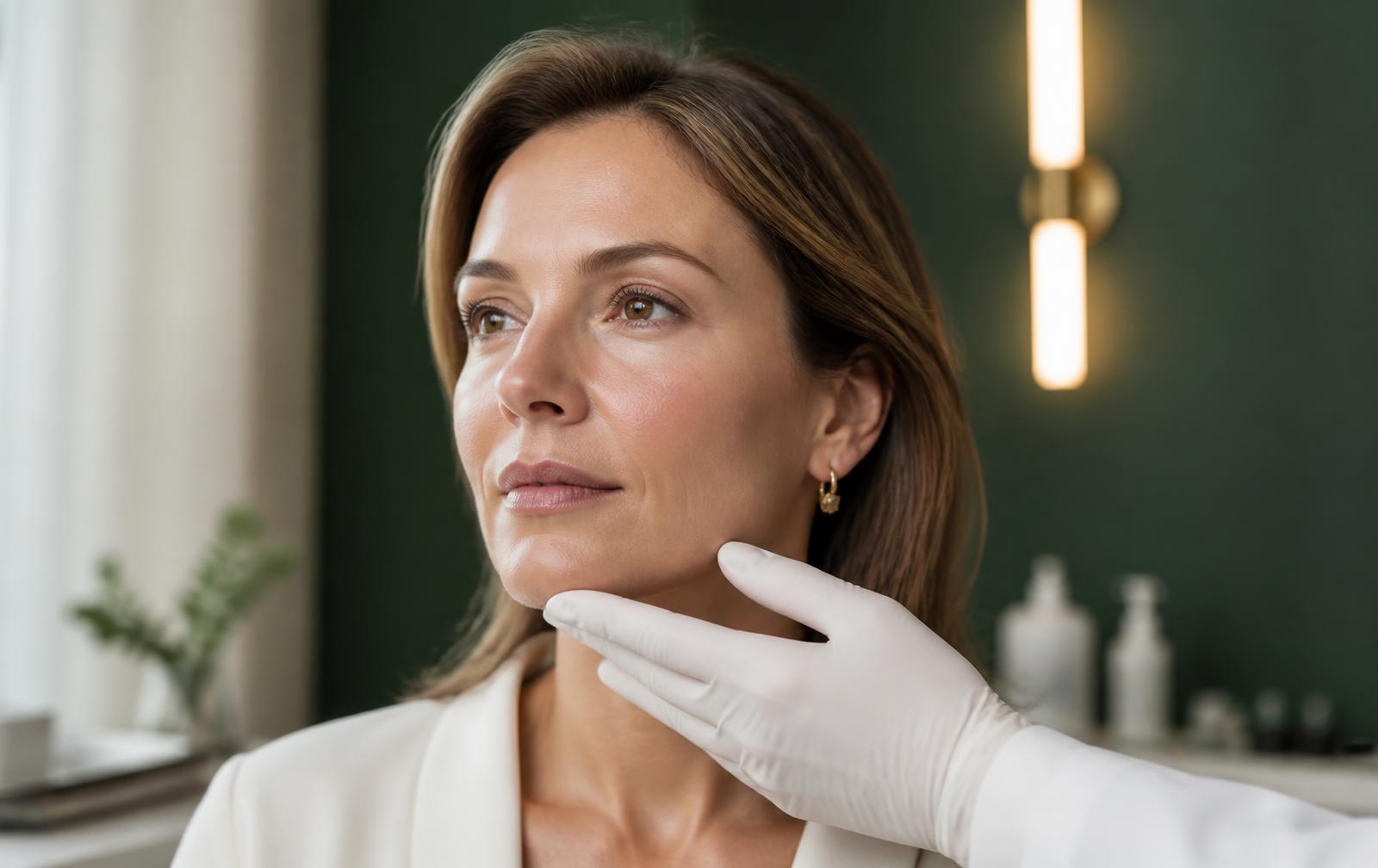
At Amara, we are. Because the face is where we see the aesthetic cost of fast weight loss first, and most visibly. Clients come in six to nine months into their weight loss and tell us the same thing, almost word for word.
“I am happy with my body. I do not recognise my face.”
This piece is what we tell them. What is actually happening under the skin, why it happens faster in the face than anywhere else, and the restrained treatment sequence that gets a face back to looking like the client, only rested. Not filled. Not tightened into someone else. Restored.
Why the face changes before the body does
Facial fat is not one uniform layer. It sits in structured compartments: mid-cheek, temples, under the eyes, along the jawline, at the corner of the mouth. Those compartments are part of your face's architecture. They give the skin something to rest on. They keep the light hitting your face in the way it did in your thirties, whatever age you are now.
When you lose weight slowly, those compartments deflate gradually and the skin has time to retract along with them. When you lose weight quickly, the compartments empty out ahead of the skin. The skin, which no longer has fat pushing it out from underneath, has nowhere to go. It hangs.
This is why fast weight loss shows in the face months before it shows in the rest of the body. Facial skin is thinner than body skin. Facial fat compartments are smaller and lose volume disproportionately. And unlike the abdomen or arms, the face has no clothing to hide behind.
The medical class of weight loss medications currently in wide use tends to produce fat loss at a rate the face was not designed to keep up with. This is not a criticism of the medications. It is a description of what the tissue does when the loss rate outpaces the skin's ability to adapt.
The three-part pattern we see in the clinic
When a client comes in for a face consultation after significant weight loss, we are almost always looking at three things happening together.
Volume loss
The mid-cheek flattens. The temples hollow. The under-eye area, which used to blend into a full upper cheek, now shows a distinct trough. The jawline, which used to be defined by fullness above and structure below, loses the fullness and starts to look more prominent in a hollow way rather than a sculpted way.
Laxity
Skin that no longer has fat pushing it outward starts to sag along the lines of least resistance. That is the nasolabial fold deepening, the jowl beginning to descend, the neck starting to show cords. Laxity is what makes the face look older than the client feels, and it is the change that upsets people the most.
Quality change
Weight loss at speed is often accompanied by dehydration, reduced protein intake, disrupted sleep and increased stress. Skin quality suffers. Fine lines become more visible. Skin looks papery, thinner, greyer. This is the change that photographs badly and that no filter can fix.
Those three things arrive together, on the same face, in the same six to twelve month window. That is why the change feels so sudden even though the weight came off gradually.
The restraint principle: you cannot fill your way out of this
The first instinct almost every client arrives with is “fill it back in.” Sit me down, put filler where the fat used to be, give me my old face back.
We understand the instinct. We rarely follow it.
Here is why. The face that lost the weight is not the same face that had the weight in the first place. Skin quality has changed. Support structures have changed. Filler behaves differently in a face that has recently lost significant weight than it does in a face at stable weight. Overfill in this specific context is the fastest route to the pillow-cheek, overdone look that ages a client by ten years in the direction they were trying to avoid.
Restraint here is not aesthetic conservatism. It is what protects the result. A face treated for weight-loss changes with heavy filler at month six often looks worse at month twelve than a face left alone. The skin continues to adapt for up to a year. Structural intervention on an unstable canvas is bad medicine.
Our approach is to work in the opposite order to what most clinics do. Skin quality first. Then modest structural support. Then, if it is still needed after the face has stabilised, targeted volume.
What actually works, and in what order
Every plan is different, and no blog post is a substitute for a consultation. But this is the sequence we most often recommend for a client presenting three to nine months after significant weight loss.
Stage one: rebuild the skin
Before any structural work, we address the quality change. Skin boosters, specifically the ones that stimulate the skin to produce its own collagen and elastin rather than the ones that add volume, are the foundation. Profhilo works across the deeper layers to improve firmness and hydration. NCTF 135HA (also known as a mesotherapy cocktail) delivers a targeted nutrient mix into the upper dermis to improve tone and texture. Sunekos supports the extracellular matrix that holds the skin's structure together. These are not glow treatments. They are structural investments in a skin that has just been through a significant physiological event. Stage one usually takes eight to twelve weeks and two to three sessions. Most clients look meaningfully better at the end of stage one alone, and a small proportion do not need to go any further.
Stage two: address laxity, not volume
Once skin quality is on the mend, we look at the laxity picture. Depending on the client's face, the age of their skin, and the degree of loss, this is where we might consider HIFU (high-intensity focused ultrasound) for skin tightening, or PDO/COG threads for gentle repositioning of tissue that has descended along the jawline or in the mid-face. These are not lifts in the surgical sense. They are structural nudges. They buy the face back the outline it lost, without adding anything that was not there before.
Stage three: targeted volume, if still needed
Six months into the plan, with the skin quality restored and laxity addressed, we assess whether any actual volume replacement is warranted. Often the answer is less than the client expected at the start. Sometimes the answer is small, precise placements in the temples or the deep mid-cheek, using a filler chosen for its structural properties rather than its lift, and in quantities that most Instagram clinics would consider embarrassingly modest. Sometimes the answer is nothing at all.
This is the sequence. Skin, then structure, then, only if needed, volume. It is slower than what most clients hoped for at the first consultation. It also delivers a face that still looks like the client, which is the whole point.
The mistake we see most often (and the fix)
The single most common story we hear is a client who lost weight, felt the face change, and went to a different clinic for filler. Sometimes several sessions of filler, across cheeks, chin, jawline and lips. They arrive at Amara six months later, looking not like a rested version of themselves but like a stranger, and asking whether we can undo it.
Some of it we can. Dissolving hyaluronic acid fillers is possible, and often necessary before we can begin proper treatment. But repeated dissolving and refilling is not neutral for the skin. The tissue changes. Some effects do not fully reverse.
The fix, and the reason we are writing this piece, is to catch clients before the mistake. If you are on a significant weight loss course and starting to see the change in your face, the right first move is a consultation about skin quality and sequencing, not an appointment for cheek filler. Restraint at month six protects you from having to undo something at month eighteen.
What we tell clients to do before the face becomes a problem
For clients who are still in the weight loss phase and thinking ahead, there are things worth doing now that materially change the aesthetic picture nine months from now.
Protein
Fast weight loss with insufficient protein means muscle loss, and facial appearance is partly held up by the muscles under the skin. Aim for the protein intake your prescribing clinician or a registered dietitian recommends for your weight and rate of loss.
Resistance training
Preserving lean mass across the whole body protects facial appearance. Cardio-only weight loss produces a worse face outcome than weight loss combined with strength work.
Rate of loss
Where you have any control over it, slower loss is better for the face. The medications work faster than the skin adapts, so buying the skin more time to keep up is one of the few structural interventions that costs nothing.
Skin barrier care
Now is not the time for aggressive actives. Retinoids, strong acids and mechanical exfoliation on a skin that is already under physiological stress creates barrier damage that shows up later as thin, papery skin. A simple regime of gentle cleanser, hyaluronic acid serum, ceramide moisturiser and SPF is doing more for your face than a ten-step routine right now.
Sleep and stress
Both directly affect skin quality and both are often disrupted during rapid weight loss. Sleep is when the skin does its structural repair. There is no filler for chronic sleep deprivation.
None of this is glamorous. All of it is what actually determines whether your face at month twelve looks like you at your best, or like you at your most tired.
Frequently asked questions
Book a face consultation
If you are seeing the change in your face after significant weight loss and want an honest assessment, book a consultation with our doctor-led team at Amara Clinic in North West London.
We will look at your skin, your face and the changes you are seeing. We will tell you what we think is worth treating now, what is worth waiting on, and what will settle on its own without our help. And we will give you a staged plan with clear pricing, not a package designed to sell you the most treatment.
Amara Clinic, 665 Finchley Road, London NW2 2HN. Doctor-led care. English and Arabic spoken.
This article is for information only and does not constitute medical advice. Aesthetic treatments are subject to consultation and suitability assessment at the clinic. This article does not describe, endorse or promote any prescription weight-management medication or medical weight-management service.